


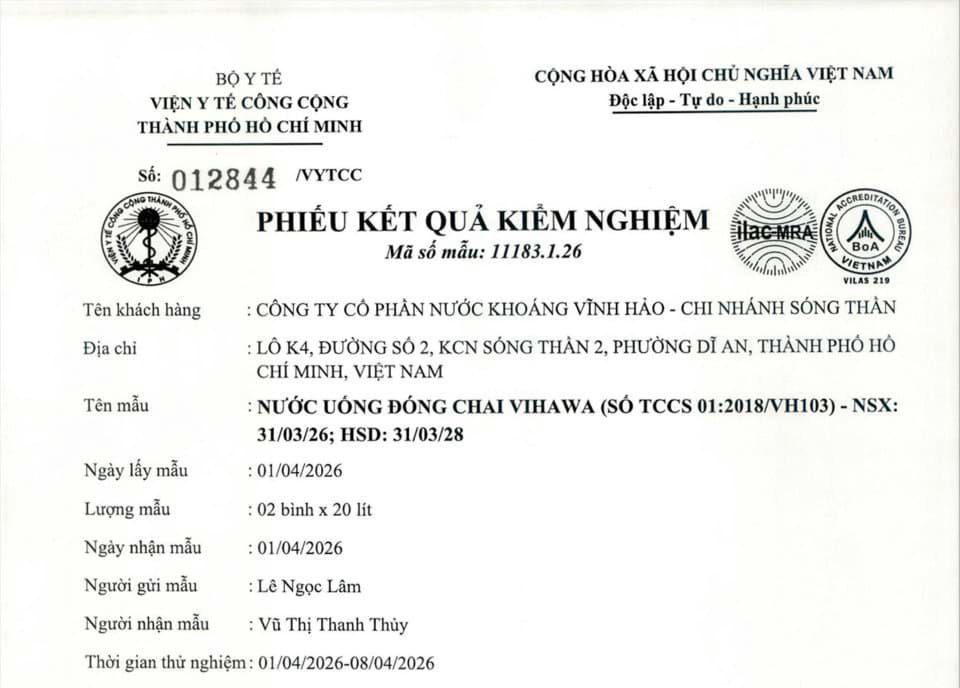
Vihawa Bottled Drinking Water Test Results
Vihawa bottled drinking water is a product tested for multiple groups of indicators related to drinking water quality and safety. The test report was conducted for the Vihawa Bottled Drinking Water sample, TCCS No. 01:2018/VH103.
The sample was collected on 01/04/2026 and underwent testing from 01/04/2026 to 08/04/2026. The sample consisted of 02 20-liter bottles, using the manufacturer's sealed and intact packaging.
Information on the Tested Vihawa Water Sample
- Product name: Vihawa Bottled Drinking Water.
- TCCS No.: 01:2018/VH103.
- Unit: Vinh Hao Mineral Water Joint Stock Company – Song Than Branch.
- Production date: 31/03/2026.
- Expiry date: 31/03/2028.
- Sampling date: 01/04/2026.
- Sample quantity: 02 bottles x 20 liters.
- Testing period: 01/04/2026 – 08/04/2026.
The test report was conducted by the Ho Chi Minh City Institute of Public Health – Ministry of Health. The report bears the code VILAS 219 and records tests recognized as compliant with ISO/IEC 17025:2017.
Microbiological Test Results
Microbiological indicators are among the important parameters tested for the Vihawa water sample. The test report recorded zero results for multiple microbiological indicators.
- Pseudomonas aeruginosa: 0 CFU/250 ml.
- Streptococci faecal: 0 CFU/250 ml.
- Sulfite-reducing anaerobic bacterial spores: 0 CFU/50 ml.
- Escherichia coli: 0 CFU/250 ml.
- Total coliforms: 0 CFU/250 ml.
Therefore, for the tested sample, all of the above-mentioned microbiological indicators recorded results of zero in the respective units specified in the report.
Bromate Test Results
Bromate is one of the chemical indicators tested separately in the test report for the Vihawa sample.
The result recorded Bromate not detected, with the method detection limit of 0.003 mg/l. The test was conducted according to Method 300.1, EPA: 1999.
It should be noted that the term “not detected” is used according to the wording of the test report. This means that the substance being tested was not detected at the detection limit of the testing method.
Testing of Metals and Elements
The Vihawa water sample was further tested for multiple indicators related to metals and elements. The results in the report show that many indicators were recorded as not detected.
Tested Metals
- Antimony (Sb): Not detected.
- Arsenic (As): Not detected.
- Barium (Ba): Not detected.
- Boron: Not detected.
- Cadmium (Cd): Not detected.
- Total chromium (Cr): Not detected.
- Copper (Cu): Not detected.
- Lead (Pb): Not detected.
- Manganese (Mn): Not detected.
- Mercury (Hg): Not detected.
- Molybdenum (Mo): Not detected.
- Nickel (Ni): Not detected.
- Selenium (Se): Not detected.
The above indicators were tested using the specific methods stated in the report, with many tests using SMEWW 3125 B:2023 or SMEWW 3120 B:2023.
Other Chemical Indicators
In addition to metals and Bromate, the water sample was also tested for various other chemical indicators.
- Chlorine: Not detected.
- Chlorate: Not detected.
- Chlorite: Not detected.
- Cyanide (CN⁻): Not detected.
- Fluoride (F⁻): Not detected.
- Nitrite (NO₂⁻): Not detected.
- Nitrate (NO₃): < 1.00 mg/l.
For Nitrate, the result in the report is specifically recorded as < 1.00 mg/l. Therefore, this result should not be interpreted as “0 mg/l” or “not detected”.
Radioactivity Testing
The test report also includes two indicators for total radioactivity.
- Gross alpha radioactivity: Not detected, LOD 0.025 Bq/l.
- Gross beta radioactivity: Not detected, LOD 0.050 Bq/l.
The two indicators were tested according to ISO 10704:2019 and were both recorded as not detected in the test sample at the respective detection limits of the methods.
What Does “Not Detected” Mean in a Test Report?
In the test results, some indicators are recorded as “not detected”. The report also explains LOD as Limit of Detection – the detection limit of the method.
Therefore, “not detected” should be understood to mean that the indicator being tested was not detected at the detection limit of the testing method used. This is the interpretation consistent with the technical information stated in the test report.
Scope of the Test Results
An important note stated directly on the report is: the test results are valid only for the tested sample.
The sample used for testing was contained in a sealed plastic bottle with intact manufacturer packaging. Therefore, the results in this article should be understood as the results of the specific Vihawa sample that was collected and tested, rather than being applied absolutely to all product batches.
iWater – Vihawa Water Distributor
iWater is a Vihawa water distributor, supplying products to households, offices, stores, and businesses in Ho Chi Minh City.
By selecting products with clear origins, iWater aims to supply genuine Vihawa water while helping customers easily access product information and relevant testing documents.
For the Vihawa sample tested in the report mentioned above, many important microbiological indicators recorded results of 0, while many chemical, metal, and radioactivity indicators were recorded as not detected at the corresponding testing limits.
Phone/Whatsapp: 098 290 8549 - Zalo - 0973 615 751 - Zalo
Email: nguyensiphong92@gmail.com
These results provide additional information for consumers to consider when choosing Vihawa bottled drinking water. At the same time, it should be noted that the test report only confirms the results for the tested sample within the scope specified by the testing organization.